

Article Contents
When replacing or installing uPVC windows, it is natural to focus on energy efficiency and design. Yet one essential element is often overlooked: the hardware. It supports security, durability and everyday ease of use.
In this practical guide, Caixilho PVC explains window hardware and security, from structural functions and resistance classes to established brands and maintenance, helping you make an informed choice for your home.
What is uPVC window hardware and what does it do?

uPVC window hardware comprises the metal components, including hinges, locks, handles and locking points, that allow a window to open, close and be adjusted.
These components help the window:
- maintain its seals against air, water and noise;
- resist forced entry;
- provide different opening and ventilation modes;
- stay aligned and operate smoothly over time.
Hardware connects the profile design with the window’s real-world performance.
Main types of hardware for uPVC windows
The right hardware depends on the opening mode and required level of security.
Tilt-and-turn window hardware
Widely used in Portugal, this provides two opening positions:
- full side opening;
- partial inward tilt at the top for ventilation.
It can be used with high-performance profiles from manufacturers such as Salamander and Aluplast. Suitable complete window configurations may achieve RC2 or RC3 resistance, subject to testing and certification.
Sliding window and door hardware
Often used for patio doors and balconies, sliding hardware moves the sash sideways. Premium lift-and-slide systems, including options from Cortizo, combine smooth operation with an effective seal.
Tilt-and-slide hardware
This system combines sliding operation with the compression sealing associated with tilt-and-turn windows. It suits larger openings and is designed for controlled operation, including heavier sashes within the system’s load limits.


Window security: the essential role of hardware
Good hardware is essential to a secure window. Brands such as Winkhaus, Roto and Siegenia are used in systems based on Salamander, Cortizo and Aluplast profiles. Security performance must be assessed for the complete tested window assembly under the applicable EN 1627–1630 framework.
Multipoint locking
Instead of a single locking point, this system secures the sash at several positions around the frame, helping provide:
- greater resistance to forced entry;
- better airtightness and watertightness;
- more even pressure on the seals.
For example, appropriately specified Salamander bluEvolution 92 windows can be configured for RC3 performance. The correct hardware, reinforcement, glazing and installation must all match the tested specification.
Mushroom-head security cams
These metal cams engage with matching security keeps to make it harder to lever the sash away from the frame. Higher-security configurations are available across a range of Cortizo and Aluplast systems.
Key-locking handles
A lockable handle provides an additional control against unwanted operation and can be useful on accessible ground-floor windows.
Electronic systems and sensors
Modern hardware can incorporate magnetic contacts or other sensors that communicate with alarms or home-automation systems. Depending on the system, they can report whether a window is open, closed or has been interfered with, making them useful in smart-home projects.
Microventilation: balancing comfort and security
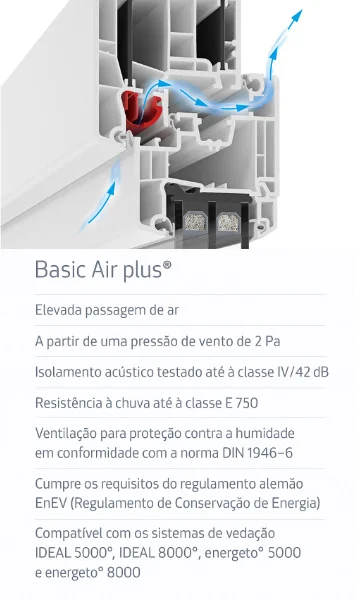
Hardware with a microventilation function holds the sash slightly open, allowing air exchange through a small gap.
This can:
- help renew indoor air;
- help manage humidity and condensation;
- provide controlled ventilation without fully opening the window.
Ventilation changes thermal performance, and a partly open window must not be assumed to offer the same security as a fully locked window. Only systems specifically tested for a secure ventilation position should be described as retaining that protection.
Microventilation is optional on some hardware ranges. Confirm its availability and security characteristics when ordering.
Compatible hardware brands and systems
Established hardware brands used with Caixilho PVC window systems include:
Winkhaus, Germany
Used with Salamander and Aluplast profiles, Winkhaus offers systems such as activPilot, featuring:
- adjustable multipoint locking;
- mushroom-style security locking cams;
- options for RC2 and RC3 window configurations, depending on the complete tested specification.
Roto Frank
Roto supplies hardware for sliding and tilt-and-turn systems. Its Roto NX range is known for durability and straightforward adjustment.
Siegenia
Siegenia offers smooth operation and options for integration with automatic ventilation and intelligent sensors, suited to modern building projects.
Hardware maintenance: essential for durability
Alongside choosing good components, regular maintenance helps a uPVC window perform well for years.
Hardware consists of mechanical parts that need periodic cleaning and lubrication. Follow the manufacturer’s instructions; a typical routine is:
| Frequency | Recommended action | Suitable product or support |
|---|---|---|
| Once a year | Lubricate hinges and locking points | Manufacturer-approved, resin-free lubricant |
| Every six months | Clean hardware with a damp cloth | Mild cleaner compatible with the finish |
| When needed | Check play and alignment | Qualified technician |
Avoid corrosive cleaners or unapproved multipurpose sprays, which may damage protective coatings and encourage corrosion.
Certification and resistance classes (RC)
Security classifications help compare tested window assemblies.
The European EN 1627–1630 framework covers burglary-resistance classification and test methods. The following is a simplified overview, not a substitute for the product’s test certificate:
| Class | General resistance level | Typical consideration |
|---|---|---|
| RC1 / RC1N | Basic resistance to opportunistic physical attack | Less accessible locations, subject to a risk assessment |
| RC2 | Resistance to specified manual attack with basic tools | Accessible windows, including many ground-floor applications |
| RC3 | Higher resistance using the specified reinforced assembly | Projects requiring enhanced protection |
Appropriate Salamander bluEvolution 92 configurations can reach RC3, while particular Cortizo uPVC systems offer tested RC2 configurations.
Aluplast systems can also use advanced security hardware. In every case, the rating depends on the complete combination of components and the applicable certification, not the profile brand alone.
How to choose the right hardware
Look beyond appearance and consider:
- the required security level and tested resistance class;
- the most practical opening mode for each room;
- the hardware brand and model, such as Winkhaus, Roto or Siegenia;
- options for microventilation and key-locking handles;
- the installer’s warranty and after-sales support.
Ask for a tailored quote that identifies the exact hardware and certification provided by each window configuration.
Why choose Caixilho PVC?
Alongside profiles from Salamander, Aluplast and Cortizo, Caixilho PVC provides specialist technical guidance and professional installation.
We work with original hardware from European manufacturers, selecting systems for security, comfort and long service life.
Request your free window quote to find the hardware system best suited to your home.
Frequently asked questions about window hardware and security
How do I choose the right hardware for uPVC windows?
The choice depends on the window type, required security level and local environmental conditions. Caixilho PVC assesses each project to recommend a suitable combination of profile, glazing and Winkhaus hardware for performance, security and durability. Request a free quote for your windows.
Does Winkhaus hardware need maintenance?
Maintenance is straightforward: clean the hardware periodically, lightly lubricate moving points as recommended by the manufacturer, typically once a year, and check window alignment. This helps the hardware operate well for many years.
Does hardware affect acoustic insulation?
Yes. A well-sealed window with even multipoint closing pressure helps reduce sound leakage.
Which hardware is best for uPVC windows?
It depends on the opening type and security requirements. Winkhaus, Roto and Siegenia are established manufacturers known for reliable systems.
Is microventilation included as standard?
This depends on the hardware range and brand. Some include it; others offer it as an option.
Can I improve the security of existing windows?
In many cases, compatible modern locking components can replace older hardware. A technician should check the complete window and confirm which upgrades are suitable.
Do all uPVC windows have security hardware?
No. Resistance ratings such as RC2 or RC3 apply only to appropriately specified and tested complete window assemblies, including suitable locking points, hardware, glazing and reinforcement.